‘From the World of John Wick: Ballerina’ – Review






From the World of John Wick: Ballerina is not trying to out-Wick John Wick, and that’s what, for the most part, makes it interesting. Directed by Len Wiseman (Underworld), this spin-off stretches its legs into balletic violence, operatic revenge, and neon-soaked grief, but it doesn’t always stick the landing. Pulling back from the franchise’s relentless action, the film explores something moodier, more character-driven, and, at times, quite beautiful. It’s a stylish, emotional revenge story that carves out its own space in the Wick-verse with poise and ambition. Call it John Wick Lite; filtered through a darker, slower lens.
Taking place between the events of John Wick: Chapter 3 – Parabellum and John Wick: Chapter 4, Eve Macarro (Ana de Armas), a ballerina-assassin, begins to train in the assassin traditions of the Ruska Roma and sets out to exact revenge for her father’s death.
Ana de Armas takes center stage as Eve Macarro, an assassin raised in the shadowy world of the Ruska Roma; the same back-tattooed ballerina syndicate glimpsed in earlier Wick chapters. Her mission is pure vengeance: to track down the men who killed her family. Classic John Wick territory. But Ballerina opts for a more reflective, melancholic tone. It’s not a wall-to-wall action ride. It’s a slow burn symphony of violence; fewer bullets, more bruises.
De Armas delivers. She’s not just a dancer with a gun, she brings real emotional heft to the role. Eve is quiet, haunted, and determined. You buy her grief, and you buy her rage. She proves she’s more than just a pretty trigger finger. Physically, she’s completely convincing: nimble, deadly, and precise. But the story lets her down. Her arc is compelling in theory, but too thin in the telling.
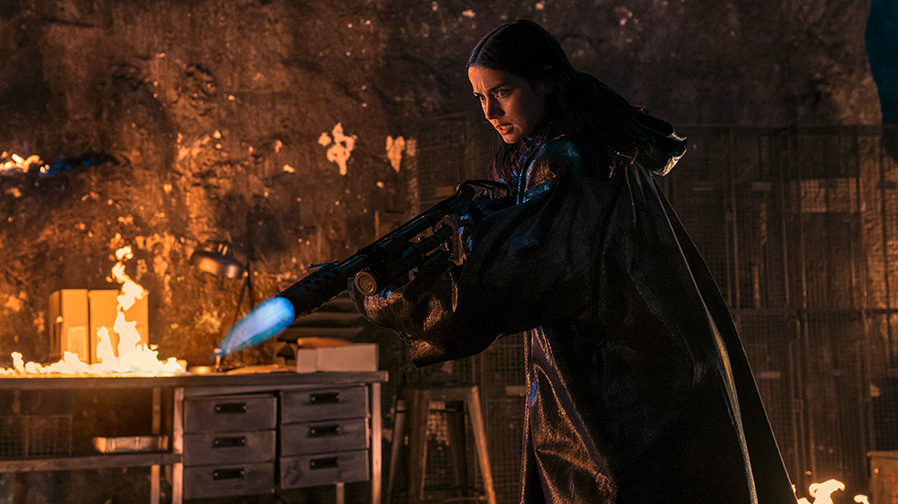
The action, while more sparing than in the mainline Wick films, is still slick and satisfying. There’s an icy shootout on a snow-draped hillside that plays out like a deadly duet, and a tense hallway gunfight that brings back that beloved, balletic gun-fu energy. Wiseman opts for clarity over chaos, and the choreography, when it hits, feels sharp and purposeful. It’s not wall-to-wall mayhem, but when the film wants to move, it does so with style.
Where Ballerina really impresses is in its atmosphere. Cinematographer Romain Lacourbas paints the world in rich shadows, blood reds, and deep blues. Every frame feels carefully composed, almost theatrical. If the Wick universe has always felt like a stylised, operatic dream of violence, Ballerina leans into that and adds a mournful beauty. It’s a ballet of grief and revenge, and it commits to that aesthetic fully.
The familiar faces offer a welcome tether. Keanu Reeves’ brief return as Wick doesn’t steal the show, but it adds gravitas. He appears like a weary angel of death; his scenes with de Armas are quiet, sombre, and surprisingly tender. Anjelica Huston returns as The Director, the steely ballet matron, dripping menace. Gabriel Byrne brings a sense of dead-eyed creep as cult leader, The Chancellor. While Norman Reedus as the mysterious and tough Daniel Pine appears both charming and cryptic, with his finger on the trigger, he’s able to differentiate himself from Reeves’ Wick in his presence as an assassin.
The film occasionally feels caught between wanting to be a meditative character piece and a revenge thriller. But even in its slower moments, Ballerina remains visually arresting and emotionally sincere. It’s clear this isn’t just a cash-in spin-off. Ballerina tries something different, and while it doesn’t always land every step, it deserves credit for taking the risk. It expands the world of John Wick with elegance and feeling, offering a more intimate look at the kind of character who might otherwise be background cannon fodder in a bigger film.
If you’re expecting non-stop action, this might feel like a change of pace; but it’s one worth embracing. Ballerina dances to its own rhythm, and in doing so, opens up the Wick-verse in bold, unexpected ways.
Image: Roadshow Films