‘Spartacus: House of Ashur’ – Review







There are moments in television where the sands shift, the heavens crack open, and audiences are reminded, viscerally, ferociously, of the power of mythic storytelling. In the early 2010s, STARZ’s Spartacus was exactly that kind of lightning strike. It was bold. It was dominant. It was unapologetically operatic. With the late Andy Whitfield and successor Liam McIntyre leading the charge, the saga of the Thracian rebel burned its way into pop culture, leaving a trail of blood, tears, and triumph in its wake. When Spartacus: War of the Damned closed the chapter on this legendary rebellion, many believed the tale was sealed in the annals of television history forever.
But the gods apparently had other plans. Through the cunning and creative audacity of series creator Steven S. DeKnight, the world of Spartacus returns, but not as expected. Not as a retread. Not as a mere resurrection. Instead, it arrives reborn in flame and fury as a “what if” saga of staggering ambition. This is Spartacus: House of Ashur, a ruthless new vision of the Roman world, and it is without question one of the most badass, intoxicating, and audacious premieres of the year. With blood, decadence, political venom, and a towering character transformation, House of Ashur reignites the franchise with volcanic force.
And at the centre of it all?
Ashur. The Syrian. The snake who survived. And now, for the first time, the serpent becomes the master.
Set after the defeat of Spartacus in the original series, House of Ashur poses the question: what if the villainous Syrian hadn’t died on Mount Vesuvius at the end of Spartacus: Vengeance? And what if he had been gifted the gladiator school once owned by Batiatus in return for aiding the Romans in killing Spartacus and putting an end to the slave rebellion?
The boldest decision House of Ashur makes—and what instantly elevates it into must-watch territory—is its core premise: a divergent timeline where the cunning Syrian slave Ashur (Nick E. Tarabay) seizes a moment of perfect treachery and ends the life of Spartacus himself. In this alternate history, fate is rewritten. Ashur claims victory. And his ambition does not go unrewarded.
Elevated by none other than Marcus Crassus (Simon Merrells), Ashur is granted status, wealth, and dominion. Now the lanista of the newly christened House of Ashur in Capua, he stands in a position he never dreamed possible, and must navigate the treacherous labyrinth of Roman aristocracy to keep it. The series wastes no time diving into the serpentine politics of Rome’s elite, where power is an endless feast, and every participant is ready to stab through the table.
This is where House of Ashur electrifies the screen.
DeKnight takes everything audiences loved about the original series: gladiatorial spectacle, moral depravity, melodramatic thrills, and pivots it into a razor-sharp examination of political manipulation, class ambition, and the intoxicating pull of power. The rebellion may not be the focus this time, but the war for control is just as fierce.
And Ashur, once a rat in the walls, now fights as the wolf at the door.
Nick E. Tarabay has always been one of the great scene-stealers of the Spartacus franchise. His Ashur was a masterclass in slimy charisma, a villain so delightfully hateful that you relished every moment he slithered across the screen. But here, elevated to lead, Tarabay detonates with a magnitude that feels like the only natural evolution of everything he’s built before.
He becomes: The underdog. The schemer. The survivor. The master. And in this new story, the unlikely protagonist.
Tarabay’s performance is rich, layered, deeply cunning and at times unexpectedly vulnerable. He wields manipulation like a blade, but he also carries the bruised soul of a man who has clawed his way out of the dirt his entire life and refuses to fall back into it. Watching him manoeuvre through Rome’s elite, outthinking, outplaying, and out-sinning everyone in his path—is addictive television, pure and simple.
This is a character we once loved to hate. Now, in a devastating twist of narrative genius… we root for him. Tarabay commands every second of screen time. He is the pulse of House of Ashur. And he absolutely delivers.
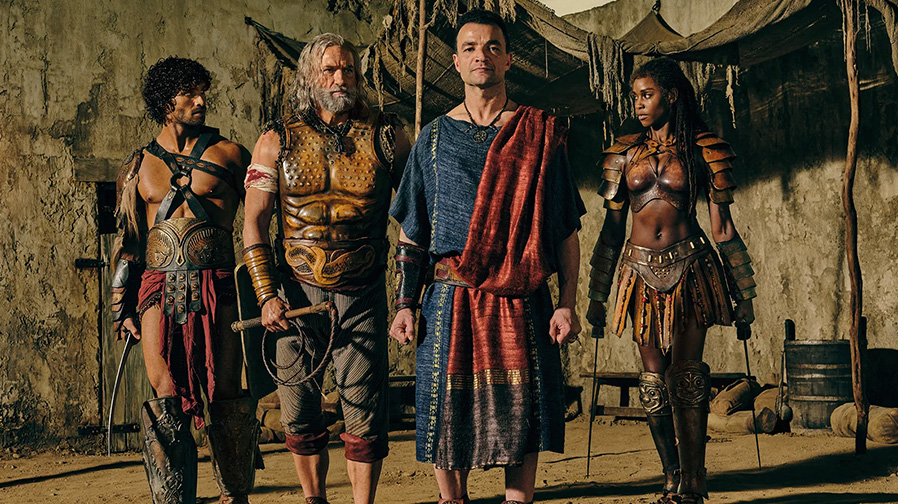
This new series introduces a host of bold and brazen characters, further expanding the intriguing world of House of Ashur. Graham McTavish delivers a titan of a performance as Korris, the Doctore of the House of Ashur, a former champion of the arena turned freeman who serves with honour, grit, and an unwavering loyalty. As Ashur’s enforcer and counsellor, he balances brute force with wisdom and gives the series a grounded, steel-edged gravitas.
Jordi Webber radiates electric arrogance as Tarchon, the golden boy of the House of Ashur, a gladiator hungry for glory, adored by crowds, and desperate to carve his name into history. Shadowing him is his father, Celadus (Dan Hamill), a seasoned veteran of the arena who carries both pride and fear for his son’s future. Their dynamic is one of the show’s most emotionally potent arcs.
Jamaica Vaughan & Ivana Baquero are the mistresses of desire and jealousy. Vaughan (as Hilara) and Baquero (as Messia) bring sensual fire and emotional complexity to the roles of Ashur’s devoted mistresses. Their devotion, jealousy, ambition, and rivalry create a swirling storm of erotic tension and political intrigue within the walls of the ludus, and both actresses relish every second.
But if there is a breakout star within House of Ashur it is unquestionably Tenika Davis as Achillia, champion gladiatrix of the house. She is a force of nature: ruthless, proud, and driven by a hunger for revenge and recognition. Her arc is brutal, blistering, and utterly commanding, and she brings a feral intensity to the arena that matches the best warriors of the original series.
The denizens of the House of Ashur are contrasted with the ruling Roman elite, resulting in plenty of dramatic moments as the aristocratic overlords of Capua reveal just how deranged and debauched they can be. Claudia Black delivers venom with elegance as Cossutia, a senator’s wife with a taste for cruelty and a vendetta against Ashur. She is privileged rot personified, and every scene she appears in tightens the noose around House of Ashur. While India Shaw-Smith, as her elegant daughter Viridia, is a fascinating contrast, an ingénue who becomes dangerously entangled with Ashur. Her presence promises a future of forbidden romance, political risk, and explosive scandal.
Adding an intriguing edge to the House of Ashur is the return of Julius Caesar, the Wolf of Crassus himself. Jackson Gallagher delivers a performance of Caesar marked by swaggering arrogance, lethal charm, and the coiled violence of a rattlesnake ready to strike. His rivalry and strange kinship with Ashur add a razor-sharp edge to the series. His desire for power is matched by his cunning and captivating wife, Cornelia (Jamie Slater). Cornelia is the ultimate antagonist of the Roman Republic; an aristocratic noblewoman with an insatiable appetite for vice and indulgence. Together, they are the Sid & Nancy of Rome; two beautiful monsters dancing on the edge of damnation. Their hedonistic chaos elevates the show’s decadence and danger to delirious new heights.
Spartacus: House of Ashur has a significant legacy to uphold, and it successfully delivers on both the violence and sensuality that fans expect from the original series. Blood flows freely in the arena and the streets of Capua, where insults and bravado lead to the unsheathing of swords. The production team once again presents an incredible choreography of death and violence that will thrill audiences, with action that is sharp and engaging.
This spectacle of gladiatorial violence is matched only by the series’ extravagant display of eroticism. All manners and expressions of the flesh are explored, catering to a wide range of erotic tastes. There are vast orgies and ample nudity, with everything taken to new heights of ecstatic expression.
However, despite its visual splendour, both the violence and sex serve storytelling purposes. These elements showcase various themes, such as Ashur’s desire for connection with his mistresses, Hilara and Messia; the expressions of dominance and power exhibited by Caesar and Cornelia; and the sincere love shared between Tarchon (Jordi Webber) and Elata (Eden Hart); a woman he can possess but can never truly have. Ultimately, the combination of violence and eroticism makes this series an even more captivating watch.
Audiences will feel the thrill of the crowd and the spectacle of the arena as Steven S. DeKnight and Nick E. Tarabay announce the vibrant return of the Roman Republic in Spartacus. House of Ashur fully embraces the fierce legacy of this beloved story and offers an exciting future as we return to the sands of the past. This series is engaging, intense, violent, sexy, and a complete experience of pure melodramatic fun.
Spartacus: House of Ashur is: violent, sexy, operatic, politically sharp, character-driven and absolutely addictive. It honours the legacy of the original while carving its own ruthless path forward, powered by Tarabay’s career-best performance and a world teeming with danger, decadence, ambition, and blood. The Roman Republic roars once more, and the sands of Capua are hungry. And with House of Ashur, the gods have granted us a gift of carnage, passion, and pure television spectacle.
Spartacus: House of Ashur will premiere with two back-to-back episodes and be available to stream weekly on Saturdays beginning December 6 exclusively on Three Now.
Image: ThreeNow

