‘The Phoenician Scheme’ – Review





There’s cinema, and then there’s Wes Anderson cinema: that entirely distinct, kaleidoscopic realm where aesthetic reigns supreme and narrative quirks coalesce into emotional resonance. With The Phoenician Scheme, Anderson once again invites audiences into his candy-colored clockwork world, but this time there’s a pulse of danger underneath the pastel — a buzz of espionage, betrayal, and familial chaos that marks a thrilling evolution in the director’s oeuvre.
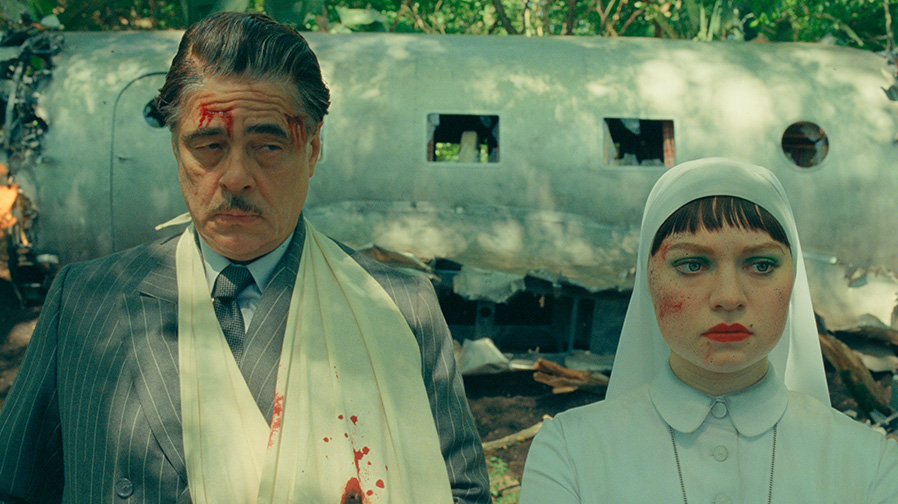
Wealthy businessman Zsa-zsa Korda (Benicio del Toro) appoints his only daughter, a nun, as sole heir to his estate. As Korda embarks on a new enterprise, they soon become the target of scheming tycoons, foreign terrorists and determined assassins.
Experiencing a Wes Anderson film up on the silver screen is always a treat to behold, and his unique mind and complete esoteric style of filmmaking shine in The Phoenician Scheme. Developed alongside longtime collaborator Roman Coppola, The Phoenician Scheme is a genre-splicing black comedy that masquerades as a Cold War-era spy thriller before unravelling into a beautifully bizarre domestic drama about legacy, loneliness, and reconciliation. It’s a film that blurs the boundaries of time, place, and tone — Casablanca meets The Royal Tenenbaums via The Lives of Others, filtered through Anderson’s bespoke lens. In short, it’s a painting of pure Anderson weirdness, and it appears like a work of art come to life
From the very first frame, Anderson’s trademark style roars to life with obsessive precision. The flat-space camera moves, rigid symmetrical compositions, and hyper-detailed production design are all dialled to eleven. But what’s most impressive here is the dynamic interplay between cold and warmth — visually, emotionally, and thematically. A stark industrial palette of slate greys and muted blues gives way to bursts of burnt oranges, crisp turquoises, and golden yellow hues reminiscent of a sun-bleached Mediterranean outpost with Mesopotamian flair. The set design alone is worth the price of admission — a living diorama packed with visual callbacks to 1920s through 1940s cinema, with Casablanca looming especially large as a clear cinematic ancestor.
At the centre of this swirling tale is Benicio del Toro as Zsa-Zsa Korda, the fabulously eccentric, world-weary arms tycoon who just might be the Richest Man in Europe, and almost certainly the most paranoid. With shades of Howard Hughes, Korda is a mesmerising figure of contradiction: a man drunk on power and riddled with regrets. Del Toro leans into the role with laconic cool and twitchy vulnerability, bringing a heavy-lidded charisma that anchors the story’s emotional weight. His performance is magnetic, and beneath all the deadpan wit and Andersonian absurdity lies a man trying desperately, if clumsily, to repair the frayed threads of family he long abandoned.
Enter Mia Threapleton as Sister Liesl, Korda’s estranged daughter turned novice nun, whose abrupt re-entry into his life acts as the emotional and narrative catalyst for the story. Threapleton is a revelation here. With her deadpan stare and monotonic delivery, she slots effortlessly into Anderson’s peculiar universe, evoking empathy and intrigue in equal measure. Her scenes with del Toro sizzle with tension and tenderness, offering a surprisingly earnest father-daughter arc that serves as the heart of this elaborate narrative clockwork.
And then there’s Michael Cera, finally, finally, in a Wes Anderson film, and it’s as perfect as it sounds. As Bjørn Lund, the neurotic, insect-obsessed private tutor to Korda’s nine sons, Cera steals every scene he’s in. Equal parts bumbling and brilliant, he’s a walking tangle of sweaters, suppressed feelings, and closely guarded secrets. His awkward romance with Liesl is both hilariously odd and genuinely affecting, and his performance serves as a brilliant reminder of how potent Cera’s comic timing can be when paired with the right material, with his delivery and goofiness leading to all sorts of laughs. He was born for this world, and now that he’s here, we never want him to leave.
The rest of the cast is filled out by a collection of fantastic performers, some newcomers, others veterans of Anderson’s creative enterprises, and all make their mark. One particular standout is Richard Ayoade as a trigger-happy Marxist revolutionary named Sergio, while Tom Hanks and Bryan Cranston as Leland and Reagan, along with Riz Ahmed as Prince Farouk, lead with del Toro what is the most unexpected and hilarious scene of the entire picture. Benedict Cumberbatch brings a sinister moustache-twirling and villainy to the picture as Uncle Nubar, and he’s bold in his performance, and makes for a presence, and the appearance of a villain that you can’t take your mind off.
What truly sets The Phoenician Scheme apart in Anderson’s filmography, however, is its tonal tightrope walk. While it maintains the filmmaker’s signature whimsy and dry wit, there’s a palpable undercurrent of danger and sadness that gives the story added gravitas. The humour is present, yes, but it’s darker, more ironic, more grown-up. Anderson seems less interested here in crafting a fairy tale and more focused on the existential unravelling of men who once believed they were in control. This is definitely unexpected territory for Anderson to play in, and you have to agree that his choices here in The Phoenician Scheme again mark his stance as one of the boldest filmmakers working today. It’s clear that this entry in his list of works will cause a reaction amongst filmgoers, particularly the Anderson faithful, and many a discussion will be held in relation to this picture.
The Phoenician Scheme is Wes Anderson at his most audacious and evolved. Presenting an inventive espionage tapestry woven with dry wit, emotional sincerity, and aesthetic bravado, it’s a film that surprises as often as it delights, and will certainly cause a reaction from audiences.
Image: Universal Pictures