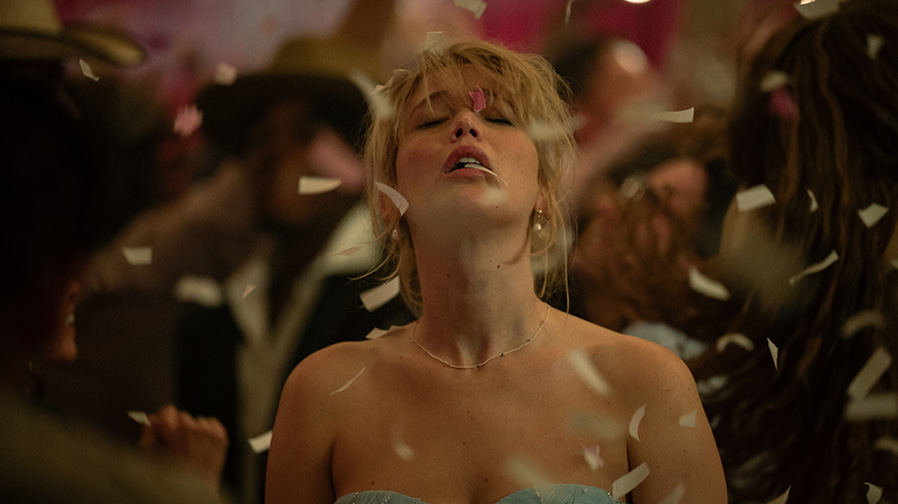
‘Die My Love’ – Review







There’s a special electricity that crackles through the cinema when an auteur decides to go all-in, and Lynne Ramsay is absolutely that kind of filmmaker. The acclaimed Scottish director has always gravitated toward the dangerous edges of human experience: toward the taboo, the uncomfortable, the brutally intimate, and she brings that fierce artistic integrity roaring into 2025 with Die My Love. Adapted from Ariana Harwicz’s cult novel, Ramsay drags its raw, raging emotional core into the wide-open loneliness of the American West and unleashes one of the year’s most uncompromising, nerve-shredding and startling visions. This is cinema you feel, in your pulse, in your breath, in the pit of your stomach.
Grace, a writer and young mother, is slowly slipping into madness. Locked away in an old house in and around Montana, we see her acting increasingly agitated and erratic, leaving her companion, Jackson, increasingly worried and helpless.
From its first frames, Die My Love refuses to sugarcoat a thing. Ramsay goes straight for the nerves, and her no-holds-barred approach to emotional chaos hits like a slap. Isolation, malaise, and the crushing hollowness of postpartum depression erupt violently into Grace and Jackson’s lives, and Ramsay captures it with a disturbingly intimate eye. The film shifts between modes effortlessly, at times feeling like a real-time psychological documentary, at others dissolving into dreamy, ethereal unreality, before tearing violently into jagged, manic madness. There’s no safe harbour here. Ramsay keeps her audience perched on the edge of a razor, and she never lets them lean back, not even for a second.
Her command of the extremities of human feeling is unflinching. This is a film about the dangerous corners of motherhood, the guilt, the rage, the hopelessness, the self-harm impulses, and Ramsay refuses to blink. It’s harrowing. It’s confrontational. But my god, it’s honest. And in that brutal clarity, the film finds its greatest power.
At the centre of this storm is Jennifer Lawrence in what is unequivocally the most fearless, most devastating performance of her career. As Grace, she removes every barrier between herself and the audience. There’s no vanity, no star aura, no protective layer, just raw nerve, exposed emotion, and the cold, unforgiving truth. Lawrence embodies a portrait of motherhood that strips away every cinematic comfort. She plays Grace as restless, volatile, yearning, furious, and heartbreakingly fragile, and as the character’s hormones, boredom, shame, and unrelenting depression drag her deeper into darkness, Lawrence commits to every moment with staggering bravery.
What makes her work so affecting is that we do see glimmers of joy, fleeting but real moments where Grace brushes against happiness, touches light, even sparkles. But Ramsay ensures they don’t last, and when the chaos swallows them, the heartbreak hits twice as hard. These scenes of collapse; messy, painful, impossible to watch without wincing are where Lawrence’s genius is at its sharpest. She doesn’t act the pain; she inhabits it. And the result is a performance that demands to be recognised and remembered.
Sharing the screen with Lawrence, and giving the story its unsettling counterpoint, is Robert Pattinson as Jackson. At first glance he’s got the cowboy charm, the grin, the easygoing banter. But Jackson is a hollow man: a smooth-talking shell filled with jealousy, dishonesty, irresponsibility and a gnawing sense of inadequacy he never quite faces. Pattinson sinks his teeth into this with a wicked sense of purpose. He plays Jackson as a man pretending to be “the man”: flirty, needy, petty, and completely out of his depth. It’s a clever, slippery performance, and the frayed, volatile chemistry between him and Lawrence gives the film its most combustible scenes. Their marriage is a slow-motion car crash you can’t tear your eyes from.
Visually, Die My Love is a knockout; a haunting, Americana-inflected fever dream that belongs on the biggest screen you can find. Cinematographer Seamus McGarvey crafts some of his most dazzling work here, leaning into extremes of colour and saturation that heighten both the beauty and the terror of Grace’s unraveling. The Montana landscapes feel mythic and merciless; the interiors claustrophobic and airless. McGarvey builds a world that mirrors Grace’s psyche; achingly beautiful one moment, sickeningly distorted the next.
Layered over this is a soundtrack that hits like a pulse: cool, unsettling, propulsive. It becomes an emotional undercurrent, winding itself into the film’s DNA and amplifying every moment of dread, desire, and descent.
Die My Love is not a comfortable film. It’s not meant to be. It is provocative, scorching, deeply disturbing, and built on pure, unrelenting artistic integrity. Ramsay isn’t interested in comforting audiences, she wants to confront them. To challenge them. To force them to sit in the mess of human emotion that most films are too scared to touch.
And in doing so, she has crafted something extraordinary.
Jennifer Lawrence delivers a career-high performance; bold, brutal, unguarded. Robert Pattinson, meanwhile, dismantles the myth of the rugged western man with sly precision. And Ramsay orchestrates it all with the precision of a master whose vision burns brighter and more ferociously than ever.
You don’t walk away from Die My Love untouched. It lingers. It gnaws. It unsettles. Days later you’ll still be thinking about it—about Grace, about Jackson, about the rawness of what you witnessed, and you’ll feel that eerie pull to revisit it, to re-examine it, to confront it again. Die My Love is not just a film. It’s an experience. A challenge. And one of the defining cinematic gut-punches of 2025.
Image: MadMan Entertainment