‘Lee Cronin’s The Mummy’ – Ancient Evil, Modern Horror — And No Way Out – Review






With Evil Dead Rise, Irish filmmaker Lee Cronin announced himself as a fearless new voice in modern horror — a director unafraid to plunge audiences into viscera, chaos, and pure, unrelenting dread. Now, with Lee Cronin’s The Mummy, Cronin doubles down, delivering a film that claws, snarls, and screams its way into your psyche. This isn’t a crowd-pleasing throwback. It’s a descent. A savage, body-horror nightmare that takes the familiar and corrupts it completely, and yes, it will absolutely freak audiences the hell out. You’ve been warned.
The young daughter of a journalist disappears into the desert without a trace. Eight years later, the broken family is shocked when she’s returned to them. However, what should be a joyful reunion soon turns into a living nightmare as she starts to transform into something truly horrifying.
Not Your Childhood Mummy
Let’s be clear: this is not The Mummy. There’s no swashbuckling charm, no wisecracking adventurers, no pulp spectacle. Cronin’s take is something far more sinister — a possession horror steeped in ancient myth and existential terror.
The story follows journalist Charlie Cannon (Jack Reynor) and his wife, Larissa (Laia Costa), whose lives were shattered when their daughter Katie vanished in Cairo. Eight years later, the unthinkable happens: Katie is found — entombed within a 3,000-year-old sarcophagus… and somehow alive.
But relief quickly curdles into dread. Because whatever has come back isn’t their daughter.
From here, Cronin unspools a relentless nightmare; a story of possession, decay, and the horrifying consequences of disturbing what should have remained buried. It’s a narrative that grips tight and refuses to let go, dragging its characters (and audience) deeper into something ancient, cruel, and inescapable.
Flesh, Fear, and Family
Make no mistake: Lee Cronin’s The Mummy is brutal. Cronin leans hard into full body horror, delivering skin-crawling imagery that will test even seasoned genre fans (yes — there are moments here that will permanently ruin something as simple as a pedicure). But beneath the gore and grotesquery lies something more grounded: a story about family.
At its core, the film interrogates sacrifice, grief, and the terrifying lengths parents will go to protect their child. Cronin balances his shocks with genuine emotional weight, crafting a narrative where the horror isn’t just external, it’s deeply personal.
If you can keep your eyes open, there’s a surprisingly affecting drama unfolding beneath the carnage, one centred on a father trying desperately to hold his family together as everything collapses around him.
A Cast Possessed
Jack Reynor continues his ascent as one of horror’s most compelling leading men, delivering a raw, unravelling performance as Charlie. His portrayal of a man caught between rationality and rising terror gives the film a strong emotional anchor, while his investigative instincts add a compelling thread of mystery to the chaos.
May Calamawy brings intensity and gravitas as Detective Dalia Zaki, grounding the film with a procedural edge that deepens the central mystery.
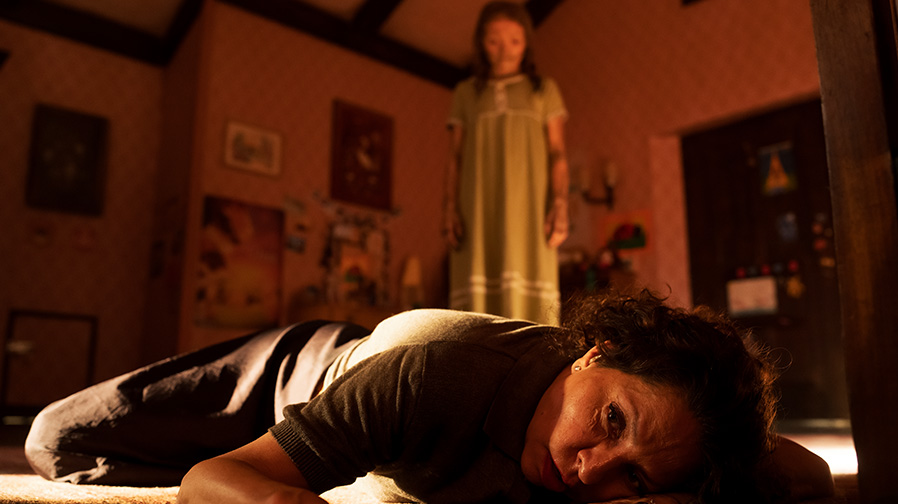
And then there’s Katie. Young actress Natalie Grace delivers a truly unnerving performance — one that evokes the legacy of Linda Blair in The Exorcist. It’s a transformation that is equal parts tragic and terrifying, filled with a creeping, snarling menace that will stay with you long after the credits roll.
Horror in the Harsh Light
One of Cronin’s smartest choices is flipping the visual language of horror on its head.
Set against the sun-scorched landscapes of New Mexico, much of The Mummy unfolds in broad daylight — all burnt oranges and glaring yellows. It’s a striking aesthetic that proves terror doesn’t need shadows to thrive. In fact, here, the light makes it worse. There’s nowhere to hide.
Cinematographer Dave Garbett captures this with a suffocating clarity, while the film’s editing and sound design — courtesy of Bryan Shaw and Peter Albrechtsen; weaponise every cut, every silence, every guttural sound. Layered over it all is Stephen McKeon’s ominous score, which seeps into your bones and refuses to let go.
Final Verdict: A Curse Worth Catching
Lee Cronin’s The Mummy is not an easy watch — nor is it meant to be. It’s vicious, grotesque, and unflinchingly committed to its vision of horror. But for those willing to endure its more extreme moments, there’s a deeply compelling story beneath the surface — one punctuated by a genuinely effective (and earned) twist ending that lingers long after the film is over.
Lee Cronin hasn’t just reimagined a classic monster — he’s desecrated it, reshaped it, and turned it into something far more dangerous. This is horror with teeth. And once it bites, it doesn’t let go.
Image: Warner Bothers Pictures