‘Hamnet’ – Review







Sometimes a piece of cinema comes along that does more than simply tell a story — it reaches inside you, takes hold, and refuses to let go. By the time the final image fades and the screen drifts to black, you are left quietly undone, emotionally spent, and deeply moved. Academy Award® winner Chloé Zhao’s Hamnet is precisely that kind of film: a tender, devastating, and profoundly human portrait of love, grief, creativity, and renewal. It is a work of aching beauty, and one that lingers in the heart long after its final moments.
From Academy Award® winning writer/director Chloé Zhao, Hamnet tells the powerful love story that inspired the creation of Shakespeare’s timeless masterpiece, Hamlet.
Adapted from Maggie O’Farrell’s celebrated novel, Hamnet reframes the legacy of William Shakespeare by shifting the focus away from the myth and toward the life that shaped him, specifically, the love he shared with his wife Agnes, and the loss that would alter them both forever. Rather than a conventional historical drama, Zhao delivers something far more intimate: a sensory, emotionally driven exploration of a marriage, a family, and the quiet, shattering impact of tragedy.
Zhao, who previously stunned audiences with the gentle humanism of Nomadland, once again proves herself a filmmaker deeply attuned to emotional truth. Her approach to Hamnet is unhurried and deliberately paced, allowing feeling to take precedence over exposition. This is not a film that explains itself; it asks you to feel it. Every gesture, glance, and silence carries meaning. Love, hope, despair, and memory circulate through the film like breath through lungs, and Zhao’s confidence as a storyteller allows those emotions to bloom naturally, without force or artifice.
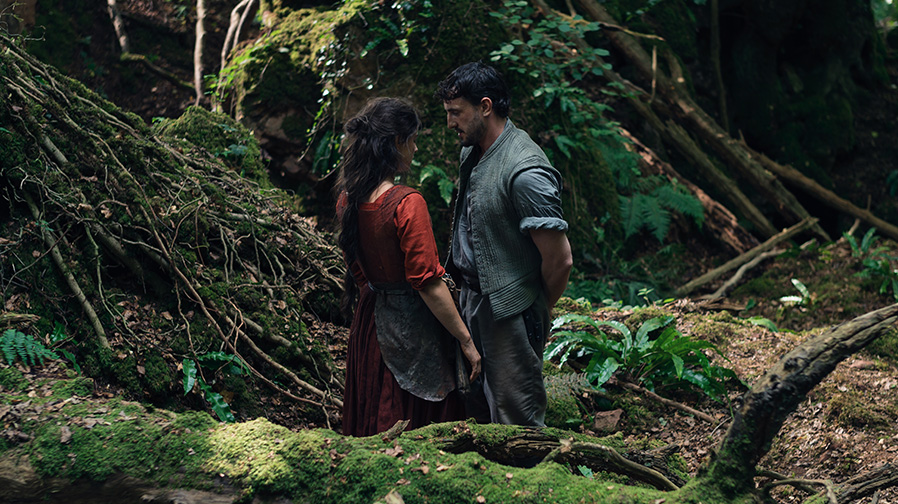
The world of Hamnet is rendered with extraordinary tactility and texture. Cinematographer Łukasz Żal captures Elizabethan England with a grounded, earthy beauty, candlelit interiors, soft dawns spilling across fields, and gardens alive with quiet life. There is a lived-in authenticity to the imagery, one that makes the film feel less like a period piece and more like a memory being gently recalled. This visual poetry is further elevated by Max Richter’s exquisite score, which swells and recedes with aching restraint. Music, image, and emotion intertwine seamlessly, drawing the audience ever deeper into the film’s emotional core.
At the centre of it all is Jessie Buckley, delivering a performance of staggering depth and vulnerability as Agnes Hathaway. Buckley doesn’t simply play Agnes, she inhabits her completely. Her Agnes is fierce, intuitive, loving, and spiritually grounded, a woman deeply connected to the rhythms of the natural world and the emotional undercurrents of her family. As a wife, mother, and individual navigating unspeakable loss, Buckley presents a portrayal that feels utterly unfiltered. There is no romantic gloss placed over grief here, instead, we witness its raw, consuming force and the quiet resilience required to survive it. Buckley’s performance is extraordinary, a soul-deep exploration of motherhood and love that will leave audiences profoundly shaken.
Opposite her, Paul Mescal delivers a beautifully restrained and quietly powerful turn as William Shakespeare. This is not the grand literary icon carved into history books, but a restless, searching man; a husband, a father, and an artist grappling with the limits of language in the face of unbearable pain. Mescal imbues Will with a constant sense of motion, as though his mind can never quite settle. Ideas churn, words form and dissolve, and grief manifests differently within him than it does in Agnes. Where she turns inward, he searches outward, trying to transform loss into meaning. Mescal captures this inner conflict with remarkable subtlety, and his chemistry with Buckley is electric, their shared scenes charged with tenderness, passion, and unspoken understanding.
One of Hamnet’s greatest strengths lies in Zhao’s ability to weave Shakespeare’s own works into the emotional fabric of the film. Moments from his canon echo through the narrative, not as literary references, but as emotional reflections, art born from pain, memory shaped into language. In doing so, the film becomes a meditation on creativity itself, presenting art as both refuge and reckoning. The film’s third act, in particular, is devastating in its honesty, confronting grief head-on while also offering the possibility of renewal through connection and creation.
What ultimately sets Hamnet apart is its overwhelming sense of empathy. This is a film that understands loss not as a single moment, but as a lifelong companion, something that reshapes love rather than extinguishing it. Zhao approaches this truth with immense compassion, crafting a story that acknowledges sorrow while still holding space for beauty, hope, and enduring connection.
Hamnet is a film of rare emotional clarity and grace. It is moving without manipulation, poetic without pretension, and deeply human in every sense. Anchored by sublime performances from Jessie Buckley and Paul Mescal, and guided by Chloé Zhao’s assured, empathetic vision, it stands as one of the most heartfelt cinematic experiences in recent memory. Bring tissues, take a breath, and surrender yourself to it; Hamnet will break your heart, and then gently show you how to carry the pieces forward.
Image: Universal Pictures