‘The Odyssey’ – Christopher Nolen delivers a ‘thinking man’s’ blockbuster – Review






Whenever filmmaker Christopher Nolan is set to take on a new project, it always draws plenty of attention, and his choice to bring Homer’s The Odyssey to life on the big screen is one of immense intrigue and thought. Nolan takes this divine work and delivers an intellectual and thoughtful presentation on a classic work, telling it in his own unique frame and idea.
The Odyssey follows Odysseus, the legendary Greek king of Ithaca, on his long and perilous journey home following the Trojan War, chronicling his encounters with mythical beings such as the Cyclops Polyphemus, sirens, and the nymph Calypso, while attempting to reunite with his wife, Penelope.
Nolan’s Complete Vision
As a filmmaker, Christopher Nolan is a force of nature who redefined the blockbuster movie experience beginning with 2005’s Batman Begins, and who has successfully tread the line between high-end action blockbuster filmmaking and more intriguing, thought-provoking arthouse work; in my mind, The Odyssey sits there. Interpreting the nearly 3000 year old work of Homer’s in his own vision, audiences find themselves watching a production that is filtered deliberating through Nolan’s own mind, and you almost feel like he’s exploring further ideas he previously explored in Oppenheimer with man’s unique take on both creativity leading to triumph or destruction, and it all makes for a very interesting realm on which to explore this ancient work.
Told with a structure that moves back and forth across time, itself a fabled Nolan trope, we come to see a disjointed and lost Odysseus who following the fall of Troy searches for a way to get back to his ancient home of Ithica, and tis narrative is juxtaposed with his loyal wife Penelope (Anne Hathaway) and his son Telemachus (Tom Holland) who wait holding out hope in Ithica for Odysseus return all while a vile group of suitors, led by the cruel and sadistic Antinous (Robert Pattinson) scheme and vie for Penelope’s hand in marriage, and total control of Ithica. With such a sprawling canvas, Nolan’s The Odyssey approaches its subject matter through a lens of memory, rage, and the passage of time, and it is less your standard action-adventure picture and more a thinking man’s blockbuster. Violence and action abound, but all of it is in service to Nolan’s study of the figure of Odysseus, and this work almost feels like a character study of a classical character, with all the veneer and polish stripped away so only the man is left.
A Cast of Titans
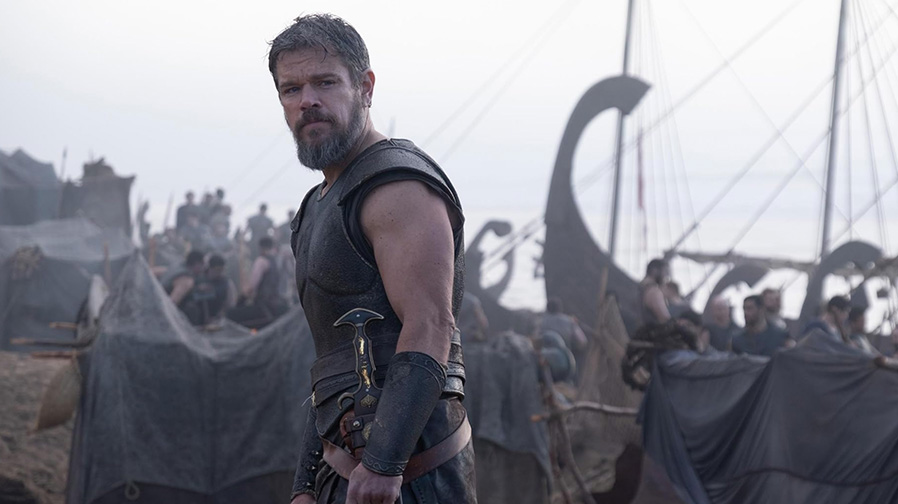
For Matt Damon, The Odyssey feels like an interesting choice for studying a hero stripped of his power and forced to contend with the reactive forces of fate and the will of the gods. Damon cuts a striking figure as the powerful Odysseus, but here Nolan really shows us him as an ordinary, if not gifted man, who is tested by the gods, must contend with forces beyond his control, and which test his will to its very limit. Damon delivers a man wrestling with the past and the consequences of his choices, making for a nuanced portrait of the legendary hero.
Juxtaposed with him are Anne Hathaway as his great love, Penelope, and Tom Holland as his loyal son, Telemachus, both of whom serve key roles in the production. For Anne Hathaway’s Penelope, we find a woman wrestling with the pain of longing, holding on by a very thin thread; she sees the bigger plan at play in Ithaca. Immense emotional power drives her performance as Penelope, and we see her holding on to her husband’s memory for dear life. Holland as Telemachus is a young man with everything to prove, but who is not schooled in the art of palace politics, and who must suffer the viper-like motions of the suitors who sit in his father’s hall. Seeking a chance to prove himself, he ventures out into the unknown, desperate for answers, and has to follow a path that will finally turn him into a man without his father’s presence.
Nolan’s The Odyssey also features a large cast of supporting characters, with some key standouts. Robert Pattinson’s Antinous, the leading suitor to Penelope, is a vicious and vile character who moves like a viper through Odysseus’ hall in Ithaca, seeking a way to claim what we view as his, and he’s incredibly frosty and repellent and again plays into Pattinson’s wheelhouse of delivering characters who can truly stand out. John. Bernthal also makes a solid presence as Menelaus, King of Sparta and husband to Helen, whose rage incites the Trojan war, and he delivers a hulking, muscular presence to the film, which is tinged by arrogance and power, but whose adherence to honour and loyalty leaves its mark on Telemachus. But the film’s scene-stealer is, hands down, John Leguizamo as Eumaeus, Odysseus’s faithful servant and blind swineherd, who holds to his master’s return and utterly seizes the audience’s attention with his performance.
Sheer Spectacle
In terms of the experience of Nolan’s The Odyssey, this is a picture where the fantasy is made real, and Nolan brings to life the famous moments that have defined Homer’s epic, from the Cyclops to the Sirens to the witchcraft of Circe, and all of it is presented in a way that feels mythical yet entirely practical and real. And all of it is captured in IMAX, making for a profound and exciting sight. Watching Nolan’s The Odyssey in IMAX is an experience unlike anything you’ve ever witnessed before.
The scale and scope only serve to magnify this gigantic story, and all of it is captured in pristine detail, with a grand attention to detail, and it utterly washes over you. Production design and the total ambience of the picture also ground the audience in the Bronze Age, and you feel like you’re watching a picture that is both ancient and also weirdly contemporary at the same time, or a legend that exists outside of time and place where mysticism and the real clash side by side, and where gods and ghosts walk amongst us. Academy Award-winning Ludwig Göransson’s soundtrack is also tempered by sounds of a time long passed, echoing with the chimes or strikings of bronze, and heavy percussion riffs that echo throughout the theatre, and again it elevates the experience of the picture.
But if The Odyssey does have a moment where its heightened feeling comes to a cataclysm then its definitely the fall of Troy, when Odysseus and Greeks creep from the Horse, and ignite a trap that sees Troy sacked and left to fiery ruin, and not only does its heat and fire and flame quench the very limits of the IMAX screen, but this moment is where the film cements its thematic moment. Told in flashbacks that move back and forth across the narrative, it is Odysseus’s revelation in the powerful third act, where both his genius and fury are visited upon the Trojans, and where Nolan’s exploration of time, memory, regret, and consequence comes into play. This third-act moment is where the whole film comes together, and its presentation of the grand theme will truly affect the audience who witness it.
Final Verdict: Nolan’s Vision
The Odyssey is a vision of cinema fully shaped by the mind of Christopher Nolan, and he takes audiences into the size and scale of this story through the immense spectacle of IMAX and delivers a narrative that is his definitive take on the subject matter of the original text.
Image: Universal Pictures